Key Highlights
- Major manufacturers are expanding their product lines through acquisitions to become comprehensive solutions providers
- Regulatory changes, such as DOE standards, are driving innovation in heat pump and hybrid system technologies
- Hybrid systems combining heat pumps with water heaters or boilers are emerging as efficient, integrated solutions, but require HVAC certification for servicing
Before I get into some of the fascinating things I learned at AHR Expo—and its implications for the skilled trades—I owe a few words of explanation to our regular readers about our lineup of columnists.
First, Marketing Columnist Matt Michel (who last wrote for us in January) had been recovering from some health issues affecting his mobility. He was no sooner up and walking than he decided he owed himself and his wife a vacation. The Michels are currently kayaking off the coast of Antarctica (!) and we hope they’re having the time of their lives.
Hydronics Columnist Pat Linhardt is also on a much-deserved break. It has taken us no less than three guest columnists to fill his hydronic shoes this month: Thomas Renner with a case study from Pennsylvania, Matt Franklin, discussing hydronics in timber-frame construction, and Stephen Onofua, exploring the future of “biomimetic” hydronics.
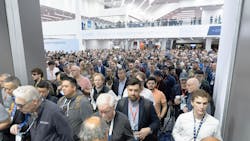
Now, the feature story this month is all about the big AHR Expo in Las Vegas—and big it was with more than 53,000 attendees, close to 2,000 exhibitors and heavy foot traffic all three days.
In years past I’ve had time to attend various education sessions at the show; this time I was almost constantly on the move trying to touch base with all the major players in the plumbing industry.
Even so, my time at the expo gave me an education on how business is changing for the key manufacturers, and how, as a result, contractors will be seeing some amazing new opportunities, and possible challenges.
The big manufacturers all seem to be in acquisition mode or working to integrate recent acquisitions. Examples include A. O. Smith with Leonard Valve (you can read my Q&A with A. O. Smith CEO Stephen Shafer), Rheem with Groupe Altantic and Fujistu General, and Bradford White with Bock Water Heaters.
Manufacturers want to expand their product offering while leveraging the strength of their well-known brands to become one-stop shops for all their customers’ needs. But there are other forces driving diversification.
The first is a push into new markets, which a wider offering makes possible. Bradford White, known for its residential water heaters, was debuting its new commercial heater at AHR. Likewise, Rinnai, known for its residential tankless units, was promoting a new 1M Btuh commercial offering.
The next is regulation. DOE standards in 2029 will require most electric water heaters to include heat pump technology. That’s a lot of technology and expertise, and for some manufacturers it makes more sense to acquire it than to develop it in-house.
But the last is a new generation of hybrid systems. Since most major manufacturers are now offering heat pumps, hybrid systems have become the next logical step. Combine a heat pump with a water heater—or a boiler, or a tankless unit—and a smart control set up and get the best capacity, efficiency and reliability all in one system.
Some of these hybrid systems come in a single appliance, but some are being developed as package systems, with all the piping ready to hook up.
For all these systems can offer the end-user, they come with challenges for the contractor. Heat pumps contain a refrigerant circuit, and that means servicing them requires HVAC certification. That means hybrid system sales and service will tend to favor larger contracting companies that employ plumbing, HVAC and electric technicians (or that rare industry savant that collects certifications like bottle caps).
Either way, it looks like the job isn’t getting less complicated anytime soon.
About the Author
Steve Spaulding
Editor-in-Chief - CONTRACTOR
Steve Spaulding is Editor-in-Chief for CONTRACTOR Magazine. He has been with the magazine since 1996, and has contributed to Radiant Living, NATE Magazine, and other Endeavor Media properties.